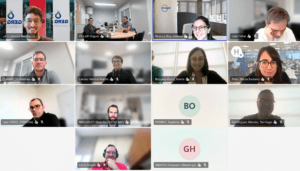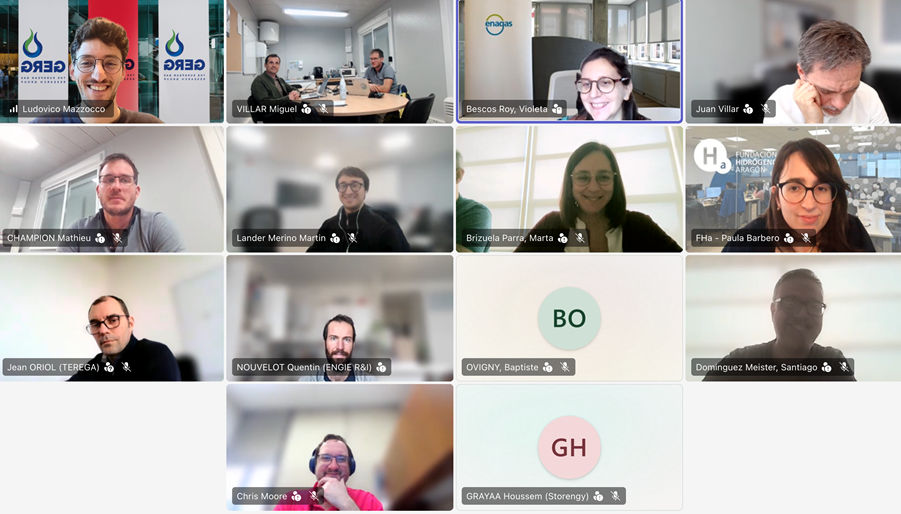
The OPTHCYS project held its latest Advisory Board Meeting on 3 March 2026, gathering consortium partners and external experts to review progress across key technical work packages. The consortium presented the results of a project that officially concluded in December 2025, sharing the findings of the research and tests conducted to validate the development of various sensing systems that will help ensure safer applications and minimise potential H₂ releases to limit the climate impact of H₂ uptake.
After a welcome from Enagás and GERG, the technical sessions began with the activities of WP2: Development of Sensoring Solutions. In this block, Lumiker reviewed the work carried out in this work package before leaving the stage for Tecnalia, to explain how they have developed a new coating material for Fibre Bragg Grating (FBG) sensors. Then, Lumiker outlined the work done in defining the FBG sensor architecture.
Then, it was time for WP3, focused on developing interrogators to process data from sensors and to develop a data processing software for H₂ leak detection. FEBUS Optics reported on the activities carried out in the work package and also showcased the results obtained for the development of an interrogator system for distributed sensing. On the other hand, Lumiker presented the process used to develop an interrogator system for FBG sensors. Moreover, the conclusions drawn from the merging of FBG and the Distributed Fibre Optics System technologies were also presented. Finally, FEBUS Optics also showcased the full software with the leakage detection model built from test results and field experience.
Afterwards, partners involved in WP4 gave their presentations, starting with the WP leader, Natran, who outlined the activities brought together, focusing on testing, validation, impact analysis, and scalability of use cases. Tecnalia presented the conclusions of the laboratory verification of FBG sensors, and the next part of this block focused on the conclusions drawn from the validations carried out during OPTHYCS. Then, Enagás, Natran and Aragón Hydrogen Foundation presented the main conclusions for midstream equipment, pipelines, and hydrogen refuelling stations. respectively. Finally, Enagás explained the results of the techno-economic assessment, compliance with the regulatory framework, and the scalability of the tools developed in OPTHYCS.
In connection with the last point, the meeting concluded with a brief overview of the roadmap that each of the Key Marketable Result (KER) must undergo before they can be brought to market. OPTHYCS has delivered three main results: a sensing system based on FBG, a sensing system based on Distributed Fibre Optics (DFO) and a sensing system combining FBG and Distributed Acoustic Sensing (DAS) in a single platform. The sensing system combining FBG and DAS will require further testing to determine the optimal configuration; the other two KERs show strong potential for future deployment within H₂ infrastructure. The FBG-based sensing system is well-suited for confined environments, whereas the DFO-based sensing system shows greater potential for hydrogen pipeline projects.