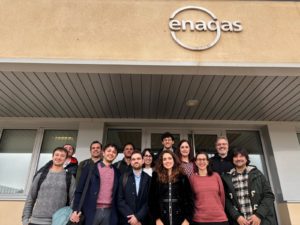
The OPTHYCS project partners met on Thursday, December 11, to hold the final face-to-face meeting of the project at the facilities of our partner Enagás (Zaragoza, Spain). All partners attended the meeting to review the project’s three-year activity.
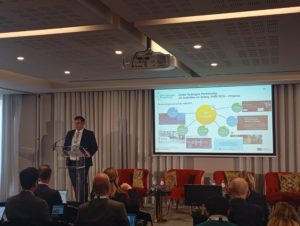
The day began with a welcome from Violeta Bescós Roy, Research Technician at host partner Enagás, followed by an agenda divided into the different OPTHYCS work packages. The first block focused on the activities of WP2: Development of Sensoring Solutions. In this block, Lander Merino, Embedded System Engineer at Lumiker, reviewed the activities carried out in this project, focusing on the work done in defining the Fibre Bragg Grating (FBG) sensor architecture. Santiago Domínguez, Researcher at Tecnalia explained their work in developing the FBG-coated sensors in collaboration with Lumiker and the development of an ad-hoc test bench to characterise the sensors’ response.
After a visit to Enagás’ laboratories, FEBUS Optics then reported on the activities carried out in WP3, focusing on the development of interrogators to process data from sensors and the development of a data processing software to process signals from single critical location sensors, interpretative software. Mathieu Champion, Pipeline Technical Lead at FEBUS explained the results obtained for the development of an interrogator system for distributed sensing and the development of the software. On the other hand, Lander Merino presented the steps and process followed in the development of an interrogator system for FBG sensors. Finally, the conclusions drawn from the merging of FBG and the Distributed Fibre Optics System technologies DFOS systems were also presented.
Afterwards, partners involved in WP4 gave their presentations, which brought together activities focused on testing, validation, impact analysis, and scalability of use cases. Santiago Domínguez presented the conclusions of the laboratory verification of FBG sensors, and the next part of this block focused on the conclusions drawn from the validations carried out during OPTHYCS. Violeta Bescós from Enagás presented the conclusions of the validation for midstream equipment; Cristina López, R&D Project Manager on Natran, did the same with the validation for pipelines, and Paula Barbero, Innovation Manager in Fundación Hidrógeno Aragón analysed the validation for hydrogen refuelling stations. Later, Cristina López retook the floor to give a general review of the KPIs for this WP and the pending deliverables.
Leaving aside the technical aspects of the project, our partner GERG presented the results of WP5, focusing on the results obtained through OPTHYCS’s communication, dissemination, and exploitation strategies. Ludovico Mazzocco, Project Officer at the organisation, analysed the impact the project has had on key stakeholders and social media. Last, Aladin Hamoud, R&I Consultant at Zabala, explained the main actions taken during 2025 on the project management (WP6) and updated the needs for 2026.
This meeting served to analyse the results of the work carried out over the last three years at OPTHYCS. Now it is time to finalise the last details and make sure that our results will lead to reinforcing the application of hydrogen, contributing to the decarbonization of energy generation, distribution, storage, and consumption.